What Are the Best Perimeter Security Options for High-Risk Sites?
High-risk sites require more than a standard gate or barrier. Critical infrastructure, utilities, data centres, logistics hubs and sensitive industrial facilities often need several layers of protection working together.
The right solution depends on the threats facing the site, the type of traffic using it and the level of control required. A strong perimeter security system should deter unauthorised access, control vehicles and pedestrians, and continue to support the day-to-day operation of the site.
Start with a site-specific risk assessment
There is no single product that is suitable for every high-risk location.
Before choosing equipment, it is important to consider:
- The main threats facing the site
- The types and sizes of vehicles using the entrance
- Pedestrian access requirements
- Daily traffic volumes
- Available space
- Required opening and closing speeds
- Emergency-service access
- Power and communication arrangements
- Maintenance and servicing requirements
This helps ensure the system is designed around the site rather than simply selecting the strongest-looking equipment.
Security-rated automatic gates
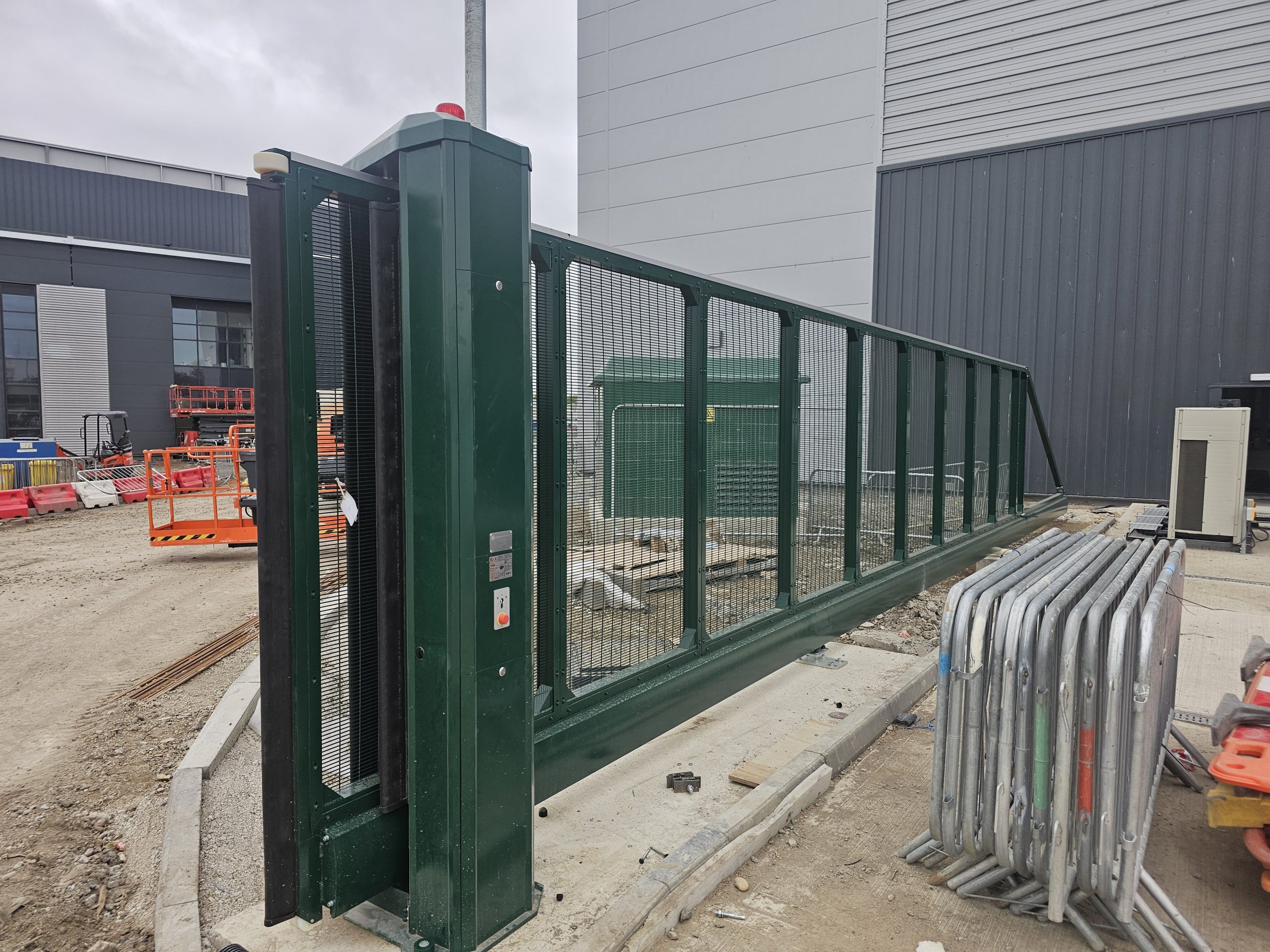
Automatic gates can provide a strong physical boundary while allowing authorised vehicles to enter and leave efficiently.
Depending on the site layout and operational requirements, suitable options may include:
- Sliding gates
- Cantilever gates
- Bi-folding speed gates
- Swing gates
- Specialist security-rated gates
Bi-folding speed gates can be particularly useful at busy or security-sensitive entrances because they open and close quickly, reducing the amount of time the access point remains exposed.
Security-rated gates may be appropriate where additional protection against forced vehicle entry is required. The correct rating and specification should always be selected according to the identified risk.
Rising bollards
Automatic rising bollards are an effective way to control vehicle access while allowing pedestrians to move freely around an entrance.
They can be used at:
- Staff entrances
- Restricted parking areas
- Industrial sites
- Public spaces
- High-security access points
Different types of bollards are available for traffic control and higher-security applications. Where vehicle impact is a concern, the selected bollard should be suitable for the required level of protection.
Drainage, foundations and underground services must also be considered during the design and installation process.
Road blockers
Road blockers provide a highly visible and robust method of controlling vehicle access.
They are often used at sites where preventing unauthorised vehicle entry is a major priority. When raised, the blocker creates a substantial physical obstacle across the roadway.
Road blockers may be suitable for:
- Critical infrastructure
- Distribution centres
- Utilities
- Government or defence-related sites
- High-value industrial facilities
- Sites with a significant vehicle threat
They can be integrated with other access-control systems to allow authorised vehicles to enter while maintaining a secure boundary.
Automatic traffic barriers
Automatic barriers are useful for controlling traffic and managing authorised vehicle movements.
They can work with:
- ANPR systems
- Key fobs
- Card readers
- Intercoms
- Vehicle detection loops
However, a standard barrier arm is primarily a traffic-management tool. At a high-risk site, it will often need to form part of a wider security system that includes gates, bollards, road blockers or other physical protection.
Turnstiles and pedestrian access systems
Vehicle security is only one part of protecting a high-risk site. Pedestrian access must also be carefully managed.
Full-height turnstiles can provide controlled entry and exit for employees, visitors and contractors. They can help reduce unauthorised access and limit the risk of one person following another through an entrance.
Other options may include:
- Waist-height turnstiles
- Secure pedestrian gates
The right system should reflect the number of people using the entrance, the required level of security and any accessibility needs.
ANPR and access control
Physical equipment becomes more effective when it is combined with reliable access-control technology.
ANPR can automatically identify authorised vehicles and provide fast access without requiring drivers to stop and present a card or key fob.
Permissions can be tailored so that different users have access to specific entrances or at certain times of day.
Access records can also help site managers review activity and identify unusual or unauthorised access attempts.
Intercom and visitor access
High-risk sites still need a secure way to manage visitors, contractors and deliveries.
A gate intercom allows staff to confirm a visitor’s identity before granting access. Depending on the site, this may be a wired, GSM or video-based system.
Preventing tailgating
Tailgating occurs when an unauthorised vehicle or person follows an authorised user through an entrance.
At vehicle entrances, this risk can be reduced through:
- Faster-closing gates
- Separate entry and exit lanes
- Vehicle detection
- Traffic lights and signage
- Road blockers or bollards
For pedestrians, full-height turnstiles and individually controlled access points can help ensure that each person presents valid credentials.
Maintenance is part of the security system
Even well-designed security equipment can become unreliable if it is not maintained.
Planned servicing can help identify:
- Mechanical wear
- Damaged safety devices
- Drainage problems
- Loose fixings
- Corrosion
- Electrical faults
- Access-control issues
- Components approaching the end of their working life
High-use or high-risk sites may require more frequent inspections than quieter locations.
Maintenance records should also be kept so that recurring faults, repairs and component replacements can be reviewed.
Why layered security matters
The strongest approach is usually to combine several forms of protection.
For example, a site may use:
- An automatic gate for the main vehicle entrance
- Rising bollards or a road blocker for additional vehicle protection
- ANPR for authorised vehicles
- An intercom for visitors
- Full-height turnstiles for staff access
Each layer performs a different role. Together, they make unauthorised access more difficult while allowing the site to operate efficiently.
Choosing the right solution
The best perimeter security system is not necessarily the one with the greatest number of products. It is the one that responds correctly to the site’s risks, layout and operational requirements.
Gateway Automation can support contractors, developers and site operators with the specification, supply, installation and maintenance of:
- Automatic security gates
- Traffic barriers
- Rising bollards
- Road blockers
- Turnstiles
- Intercoms
- ANPR and access-control systems
Contact Gateway Automation to discuss a perimeter security solution for your site.